.png)
Build a Successful Procurement and Supply Chain Career with CIPS
The procurement and supply chain industry is evolving rapidly, and organizations across Qatar are seeking skilled professionals who can manage purchasing, supplier relationships, logistics, and supply chain operations efficiently. One of the most respected qualifications in this field is offered by the Chartered Institute of Procurement & Supply (CIPS).
Whether you are starting your career, looking to advance professionally, or planning to move into procurement and supply chain management, studying CIPS in Qatar can be a valuable investment in your future.
Here are ten compelling reasons why professionals choose to pursue CIPS qualifications in Qatar.
1. Globally Recognized Qualification
CIPS is one of the world's most respected professional bodies for procurement and supply chain management. Employers across various industries recognize CIPS qualifications as a benchmark for professional competence and industry knowledge.
Holding a CIPS qualification can enhance your credibility and increase your competitiveness in the job market.
2. High Demand for Procurement Professionals in Qatar
As Qatar continues to diversify its economy under Qatar National Vision 2030, demand for qualified procurement and supply chain professionals continues to grow.
Industries actively hiring procurement professionals include:
Oil and Gas
Construction
Logistics
Manufacturing
Healthcare
Aviation
Retail
Government Organizations
Studying CIPS can help you develop the skills employers are seeking.
3. Better Career Opportunities
Professionals with procurement expertise often have access to a wide range of career opportunities.
Common roles include:
Procurement Officer
Purchasing Officer
Buyer
Procurement Specialist
Contract Administrator
Supply Chain Coordinator
Procurement Manager
Supply Chain Manager
A CIPS qualification can help open doors to these career paths in Qatar and internationally.
4. Increased Earning Potential
Employers value professionals who can reduce costs, improve supplier performance, and create strategic value for their organizations.
Because of this, qualified procurement and supply chain professionals often enjoy competitive salary packages and greater opportunities for career progression.
5. Develop Strategic Procurement Skills
Modern procurement is no longer limited to purchasing goods and services.
CIPS helps professionals develop skills in:
Strategic sourcing
Supplier relationship management
Contract management
Procurement planning
Negotiation techniques
Risk management
Sustainable procurement
These skills are highly valuable in today's business environment.
6. Gain Practical Industry Knowledge
CIPS qualifications focus on real-world procurement and supply chain challenges.
Learners gain practical insights into:
Procurement processes
Supply chain operations
Supplier evaluation
Inventory management
Ethical procurement practices
Commercial awareness
This practical knowledge can be immediately applied in the workplace.
7. International Career Mobility
One of the major advantages of studying CIPS is its global recognition.
A CIPS qualification can support career opportunities not only in Qatar but also across the Middle East, Europe, Asia, Africa, and other international markets.
For professionals seeking long-term career growth, CIPS provides a valuable global credential.
8. Learn Industry Best Practices
Organizations increasingly expect procurement teams to follow international standards and best practices.
CIPS helps learners understand:
Procurement governance
Ethical sourcing
Supply chain sustainability
Supplier performance management
Procurement regulations
These skills help professionals contribute more effectively to organizational success.
9. Professional Recognition and Membership
Studying CIPS can lead to professional membership opportunities that demonstrate your commitment to continuous professional development.
Professional recognition enhances your reputation and shows employers that you are serious about your career in procurement and supply chain management.
10. Study CIPS with Leaders Training Centre Qatar
Choosing the right learning provider is essential for success.
Leaders Training Centre is proud to be the only CIPS-approved learning provider in Qatar, offering comprehensive support for professionals pursuing CIPS qualifications.
Why choose Leaders Training Centre Qatar?
Experienced procurement and supply chain trainers
Flexible learning options
Student-focused support
Industry-relevant training
Structured exam preparation
Professional learning environment
Whether you are pursuing CIPS Level 2, Level 3, Level 4, Level 5, or Level 6 qualifications, Leaders Training Centre can help you achieve your learning and career goals.
Start Your Procurement Career Journey Today
The procurement and supply chain profession continues to grow in importance across Qatar and around the world. Organizations need professionals who can manage suppliers, optimize costs, reduce risks, and contribute strategically to business success.
By studying CIPS in Qatar, you can gain globally recognized knowledge, enhance your career opportunities, and position yourself for long-term professional growth.
If you are ready to build a future in procurement and supply chain management, Leaders Training Centre Qatar is here to support your journey.
.png)
If you are planning to study abroad, apply for immigration, or move forward in your career, your IELTS score can make a big difference.
For many students and professionals in Qatar, IELTS is not just another English test. It is the score that may decide whether you get accepted, approved, licensed, or shortlisted.
That is why choosing the right IELTS preparation course in Doha matters.
A good course does more than teach grammar and vocabulary. It shows you how the test works, where you are losing marks, and how to improve your band score with a clear plan.
In this guide, we will explain what to look for before you enroll in an IELTS course in Doha — and how Leaders Training Centre helps students prepare with structure, feedback, and confidence.
Why IELTS Matters So Much in Qatar
Doha is home to thousands of students, working professionals, and expats who need IELTS for important life goals.
You may need IELTS for:
University admission abroad
Immigration or visa applications
Professional licensing in healthcare, education, or engineering
Job applications with international companies
Scholarship applications
Career development opportunities
Because so much depends on your score, preparing alone can be risky.
Many candidates know English well but still lose marks because they do not understand the exam format, timing, or marking criteria.
That is where a structured IELTS preparation course can help.
Academic or General Training: Which IELTS Course Do You Need?
Before you start preparing, you need to know which IELTS test is right for your goal.
IELTS Academic
This is usually required for:
University admission
Higher education
Professional registration
Some licensing bodies
IELTS General Training
This is usually required for:
Immigration
Work purposes
Training programs
Secondary education in an English-speaking country
Both tests include Listening, Reading, Writing, and Speaking. However, the Reading and Writing sections are different.
A strong IELTS course should not place every student in the same track. Your trainer should first understand your goal, your current level, and your target band score.
At Leaders Training Centre in Doha, students are guided toward the right IELTS track before training begins.
What Should a Good IELTS Preparation Course Include?
Not all IELTS courses are the same. Some focus only on practice questions. Others give general English lessons without enough exam strategy.
Before you enroll, look for these key features.
1. A Diagnostic Assessment Before You Start
You cannot improve your IELTS score properly if you do not know your starting point.
A diagnostic test helps identify your level in:
Listening
Reading
Writing
Speaking
It also shows which skills need the most attention.
For example, you may be strong in Speaking but weak in Writing Task 2. Or you may understand Reading passages but struggle to finish on time.
A diagnostic assessment gives your trainer a clear picture. It also helps you track real progress during the course.
2. Training for All Four IELTS Skills
IELTS is not one skill. It is four separate skills tested under pressure.
A good IELTS preparation course should give focused practice in each area.
Listening
You need to understand different accents, follow instructions, and avoid common traps.
Reading
You need to read quickly, find answers fast, and manage difficult question types.
Writing
You need to structure your answers clearly and meet the band descriptors for grammar, vocabulary, coherence, and task response.
Speaking
You need to speak naturally, answer fully, and show fluency without memorized responses.
The best courses do not rush through these skills. They train you step by step.
3. IELTS Exam Strategy, Not Just English Practice
IELTS is not only about knowing English.
It is also about knowing how to take the test.
You need to know:
How much time to spend on each section
How to avoid distractors in Listening
How to skim and scan in Reading
How to plan Writing Task 1 and Task 2
How to answer Speaking questions with confidence
How to avoid common mistakes that lower your band score
This is one of the biggest reasons students choose an IELTS preparation course instead of preparing alone.
With the right strategy, you stop guessing and start preparing with purpose.
4. Full Mock Tests Under Exam Conditions
Practice questions are useful. But they are not enough.
You also need full mock tests that feel like the real IELTS exam.
Mock tests help you:
Build exam stamina
Manage your time
Reduce test anxiety
Identify weak areas
Measure your progress before test day
A good IELTS centre should offer timed mock tests with useful feedback. This helps you fix problems before they cost you marks in the real exam.
5. Personal Feedback on Speaking and Writing
Speaking and Writing are often the hardest sections to improve alone.
Why?
Because you need feedback.
You may not notice that your essay lacks clear paragraphing. You may not hear your own pronunciation issues. You may think your answer is complete when it is actually too short or unclear.
That is why personal feedback matters.
In a strong IELTS course, trainers should help you understand:
Why your answer received a certain band
What needs to change
How to improve your next attempt
Which mistakes you repeat often
This feedback can make a major difference, especially for students aiming for Band 6.5, 7.0, or higher.
6. Experienced IELTS Trainers
General English teaching and IELTS exam coaching are not the same.
IELTS trainers need to understand:
The test format
Band descriptors
Common student mistakes
Timing strategies
Academic and General Training requirements
How to give practical feedback
At Leaders Training Centre, IELTS training is delivered by instructors who understand exam preparation, not just general English lessons.
This helps students focus on the skills and strategies that affect their final band score.
7. Flexible IELTS Classes in Doha
Many IELTS students in Qatar are busy.
Some work full-time. Some study at university. Others are preparing for immigration or professional licensing while managing family and work responsibilities.
That is why flexible class timing matters.
When choosing an IELTS course in Doha, ask whether the centre offers:
Evening classes
Weekend options
Short intensive courses
Online or hybrid support
Class timings for working professionals
A course that fits your schedule is easier to complete — and easier to stay consistent with.
How Long Does IELTS Preparation Take?
The answer depends on your current level and your target band score.
As a general guide:
Beginner to intermediate students may need 6–8 weeks.
Intermediate to advanced students may need 3–4 weeks.
Retake candidates may need 2–3 weeks of focused support on weak areas.
For example, if you already have Band 6.5 but need Band 7.0 in Writing, you may not need a full beginner course. You may need targeted Writing feedback and exam practice.
But if you are not familiar with the test, you may need more time to build confidence across all four skills.
The safest approach is to take a diagnostic assessment first.
Common Mistakes Students Make Before IELTS
Many students lose time and money because they prepare in the wrong way.
Here are common mistakes to avoid:
1. Preparing Without a Diagnostic Test
If you do not know your current level, you cannot make a clear plan.
2. Memorizing Vocabulary Lists
IELTS rewards clear, accurate English. Using difficult words incorrectly can lower your score.
3. Ignoring Time Management
Many students know the answers but lose marks because they run out of time.
4. Practicing Speaking Alone
Speaking improves faster when you get live feedback from a trainer.
5. Choosing the Cheapest Course Only
A low price may look attractive, but check what is included. You need trainer feedback, mock tests, and updated IELTS materials.
Questions to Ask Before Choosing an IELTS Course in Doha
Before you enroll, ask these questions:
Will I prepare for IELTS Academic or General Training?
Is there a diagnostic test before the course?
Are mock tests included?
Will I receive Writing and Speaking feedback?
Are the trainers experienced in IELTS preparation?
Are the class timings suitable for my schedule?
Are the materials updated for the current IELTS format?
Can I get support if I am retaking the exam?
These questions will help you choose a course that gives real support, not just practice worksheets.
Online or In-Person IELTS Classes: Which Is Better?
Both options can work.
In-person IELTS classes
These are useful if you want direct interaction, classroom structure, and immediate feedback.
Online IELTS classes
These are helpful if you need flexibility or cannot attend classes in person.
Hybrid IELTS preparation
This gives you the benefits of both. You can attend live sessions and also use online support for revision and practice.
Leaders Training Centre offers IELTS preparation options designed for students and professionals in Doha who need flexible support.
Why Choose Leaders Training Centre for IELTS Preparation in Doha?
Leaders Training Centre helps IELTS students prepare with a clear and practical approach.
The course focuses on:
Diagnostic assessment
Academic and General Training guidance
Skill-based IELTS practice
Speaking and Writing feedback
Mock tests
Exam strategy
Flexible class timings
Support for students and working professionals
Whether your goal is university admission, immigration, professional licensing, or career growth, the right IELTS preparation can help you move forward with more confidence.
Ready to Start Your IELTS Preparation in Doha?
Do not wait until your test date is too close.
Start with a diagnostic assessment and find out exactly where you stand.
Book your IELTS diagnostic assessment at Leaders Training Centre in Doha today — and take the first step toward your target band score.
.png)
Qatar's economy continues to diversify and expand beyond the oil and gas sector. With major investments in infrastructure, logistics, manufacturing, healthcare, retail, and technology, the demand for skilled procurement and supply chain professionals in Qatar has reached unprecedented levels.
Organizations across the country are actively seeking professionals who can efficiently manage purchasing, supplier relationships, inventory, logistics, and supply chain operations. As businesses strive to improve efficiency, reduce costs, and ensure uninterrupted operations, procurement and supply chain management has become a critical business function.
For professionals looking to build a rewarding career in Qatar, acquiring procurement and supply chain management skills can open doors to excellent employment opportunities and career advancement.
Why Procurement and Supply Chain Professionals Are Essential
Every organization relies on a smooth flow of goods, services, and information. Procurement and supply chain professionals play a vital role in ensuring that businesses receive the right products, from the right suppliers, at the right time and cost.
Their responsibilities include:
Strategic sourcing and supplier management
Procurement planning and purchasing
Inventory and warehouse management
Logistics and transportation coordination
Contract management
Supply chain risk management
Cost optimization and efficiency improvement
As businesses in Qatar continue to grow, these skills are becoming increasingly valuable.
Factors Driving Demand for Procurement and Supply Chain Professionals in Qatar
1. Economic Diversification Under Qatar National Vision 2030
Qatar's long-term development strategy aims to diversify the economy by strengthening sectors such as manufacturing, logistics, healthcare, construction, and technology.
This diversification creates a growing need for procurement specialists, buyers, purchasing officers, supply chain coordinators, logistics managers, and procurement managers who can support organizational growth and operational excellence.
2. Expansion of Logistics and Transportation Sector
Qatar has invested heavily in world-class logistics infrastructure, including ports, airports, free zones, and transportation networks.
Facilities such as Hamad Port and Hamad International Airport have strengthened Qatar's position as a regional logistics hub. This expansion has increased the demand for professionals who understand supply chain planning, logistics management, and procurement processes.
3. Growth in Construction and Infrastructure Projects
Despite the completion of several major projects, Qatar continues to invest in infrastructure development, urban expansion, and industrial projects.
Construction companies require procurement professionals to manage supplier relationships, source materials, negotiate contracts, and ensure project timelines are met efficiently.
4. Digital Transformation of Supply Chains
Modern supply chains are increasingly driven by technology, data analytics, automation, and enterprise resource planning (ERP) systems.
Organizations need professionals who understand both traditional procurement practices and modern supply chain technologies. This shift has increased demand for qualified professionals with updated industry knowledge.
5. Focus on Cost Control and Efficiency
In today's competitive business environment, companies are under pressure to optimize spending and improve operational efficiency.
Procurement professionals help organizations achieve these goals by:
Negotiating better supplier contracts
Reducing procurement costs
Managing supplier performance
Minimizing operational risks
Improving supply chain visibility
As a result, skilled procurement professionals are viewed as strategic contributors to business success.
Career Opportunities in Procurement and Supply Chain in Qatar
Qualified professionals can pursue various roles, including:
Procurement Officer
Purchasing Officer
Supply Chain Coordinator
Procurement Specialist
Buyer
Logistics Coordinator
Warehouse Supervisor
Supply Chain Analyst
Procurement Manager
Supply Chain Manager
Logistics Manager
Contract Administrator
These positions are available across industries such as oil and gas, construction, healthcare, manufacturing, retail, aviation, and government sectors.
How Professional Training Can Help
While experience is valuable, employers increasingly seek candidates with formal procurement and supply chain training.
Professional training helps individuals:
Understand procurement principles and best practices
Learn supplier relationship management
Improve negotiation and contract management skills
Gain knowledge of logistics and inventory management
Enhance strategic sourcing capabilities
Stay updated with industry standards
Whether you are new to the field or looking to advance your career, structured training can significantly improve your employment prospects.
Study Procurement and Supply Chain Management at Leaders Training Centre Qatar
At Leaders Training Centre Qatar, we understand the growing demand for procurement and supply chain professionals in today's job market.
Our procurement and supply chain management training programs are designed to equip learners with practical knowledge and industry-relevant skills that employers seek. Participants gain insights into procurement processes, supplier management, inventory control, logistics operations, and strategic supply chain management.
Why choose Leaders Training Centre?
Experienced industry trainers
Practical and career-focused learning
Flexible learning options
Professional training environment
Supportive learning experience
Industry-relevant curriculum
Whether you are looking to start a career in procurement, transition into supply chain management, or enhance your existing skills, Leaders Training Centre Qatar can help you achieve your professional goals.
Conclusion
The demand for procurement and supply chain professionals in Qatar continues to rise as organizations focus on operational efficiency, strategic sourcing, and business growth. With economic diversification, expanding logistics infrastructure, and increasing reliance on efficient supply chains, procurement professionals are becoming indispensable across industries.
Now is an excellent time to invest in procurement and supply chain training and position yourself for long-term career success in Qatar.
.png)
A New Milestone in Professional HR and People Development Training
We are delighted to announce that Leaders Training Centre has officially become a CIPD Approved Centre, marking a significant milestone in our commitment to delivering world-class professional education and training.
This achievement reflects our dedication to providing high-quality learning experiences that empower individuals and organizations to excel in the fields of Human Resources, Learning & Development, and People Management.
What Does Being a CIPD Approved Centre Mean?
The Chartered Institute of Personnel and Development (CIPD) is the world's leading professional body for HR, Learning and Development, and people professionals. CIPD qualifications are recognized globally and are highly valued by employers across industries.
As a CIPD Approved Centre, Leaders Training Centre is authorized to deliver internationally recognized CIPD qualifications while maintaining the high standards of quality, learner support, and professional excellence expected by CIPD.
Launching the CIPD Level 3 Foundation Certificate in People Practice
As part of this exciting development, we are proud to offer the CIPD Level 3 Foundation Certificate in People Practice.
This qualification is designed for individuals who are:
• Beginning their career in Human Resources
• Working in HR support or administrative roles
• Looking to transition into the HR profession
• Seeking a globally recognized HR qualification
• Interested in developing people management and workplace skills
The programme provides learners with practical knowledge and professional skills in:
• Human Resources Fundamentals
• Recruitment and Selection
• Employee Relations
• Learning and Development
• Business Culture and Behaviour
• People Practice and Professional Development
Why Choose Leaders Training Centre?
At Leaders Training Centre, we are committed to helping professionals achieve their career goals through industry-relevant training and expert guidance.
Our learners benefit from:
• CIPD-approved learning and assessment standards
• Experienced and qualified trainers
• Flexible learning options
• Comprehensive learner support
• Internationally recognized certification
• Career-focused professional development
Supporting the Future of HR Professionals
Becoming a CIPD Approved Centre reinforces our mission to develop future HR leaders and people professionals who can make a meaningful impact within their organizations.
We are excited to welcome aspiring HR practitioners, administrators, team leaders, and professionals looking to build a strong foundation in people practice through the CIPD Level 3 qualification.
Join Us on This Exciting Journey
We look forward to supporting learners in achieving their professional ambitions through globally respected CIPD qualifications.
To learn more about the CIPD Level 3 Foundation Certificate in People Practice, upcoming intakes, and enrolment opportunities, contact Leaders Training Centre today.
About Leaders Training Centre
Leaders Training Centre is a leading professional training provider dedicated to delivering internationally recognized qualifications and industry-focused learning solutions. Our programmes are designed to equip professionals with the skills, knowledge, and confidence needed to succeed in today's evolving workplace.
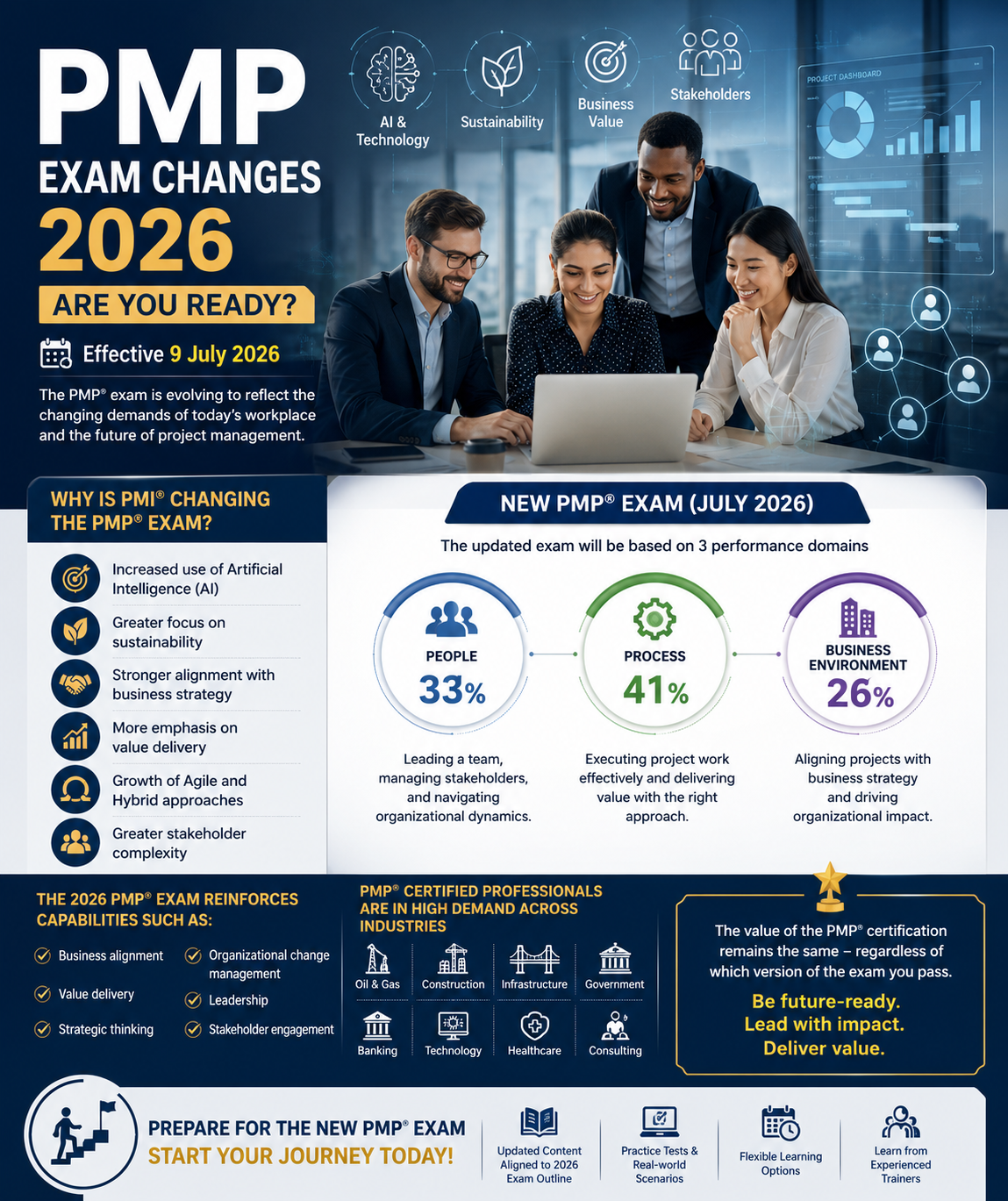
The Project Management Professional (PMP) certification has long been regarded as the gold standard for project managers worldwide. As industries evolve and organizations increasingly focus on business value, digital transformation, sustainability, and artificial intelligence, the Project Management Institute (PMI) has announced significant changes to the PMP examination effective 9 July 2026.
For professionals planning to earn their PMP certification, understanding these changes is essential. Whether you are an engineer, project coordinator, project manager, operations professional, or business leader, the new PMP exam reflects the changing demands of today’s workplace.
Why Is PMI Changing the PMP Exam?
Project management has evolved significantly over the last decade.
Organizations no longer measure success solely by completing projects on time, within scope, and within budget. Today’s businesses expect project managers to create measurable business value, align projects with strategic objectives, manage organizational change, and navigate increasingly complex stakeholder environments.
The 2026 update reflects the realities of modern project leadership, including:
* Increased use of Artificial Intelligence (AI)
* Greater focus on sustainability
* Stronger alignment with business strategy
* More emphasis on value delivery
* Growth of Agile and Hybrid approaches
* Greater stakeholder complexity
New PMP Exam (July 2026)
* People: 33%
* Process: 41%
* Business Environment: 26%
Consider Preparing for the New PMP Exam If:
* You are just beginning your PMP journey
* You do not expect to sit for the exam before July 2026
* You are interested in learning the latest project management practices
* You want your preparation aligned with the newest exam structure
The good news is that the value of the PMP certification remains exactly the same regardless of which version of the examination you pass.
The updated PMP exam reinforces capabilities such as:
* Business alignment
* Value delivery
* Strategic thinking
* Organizational change management
* Leadership
* Stakeholder engagement
Professionals who earn PMP certification will continue to be highly sought after in sectors such as:
* Oil and Gas
* Construction
* Infrastructure
* Government
* Banking
* Technology
* Healthcare
* Consulting
Final Thoughts
The PMP exam changes taking effect on 9 July 2026 reflect the evolving role of project managers in today’s business environment.
The future project manager is expected to be more than a scheduler or coordinator. Organizations now require leaders who can align projects with strategy, deliver measurable value, manage complexity, navigate uncertainty, and contribute to long-term business success.
.png)
Pressure. Complaints. Conflicts. Welcome to HR.
Human Resources is often seen as a people-focused profession, but professionals working in HR know the reality is far more demanding. From handling employee complaints and workplace conflicts to maintaining compliance and supporting business goals, HR professionals face responsibilities that require both confidence and expertise.
Modern workplaces expect HR teams to do more than manage paperwork. Today’s HR professionals are strategic partners responsible for employee engagement, organizational culture, workforce development, and business success.
This is why practical HR training and industry-recognized qualifications have become increasingly important for professionals aiming to grow in the field.
The Reality of Working in HR
Every organization depends on HR to maintain a productive and compliant workplace. However, HR responsibilities often come with challenges and pressure.
Common HR challenges include:
Managing workplace conflicts
Handling employee grievances and complaints
Maintaining HR compliance and policies
Workforce planning and talent management
Employee performance and engagement
Training and development coordination
Managing organizational change
Without the right knowledge and practical skills, these responsibilities can become difficult to manage effectively.
Why HR Skills Matter More Than Ever
Businesses are rapidly evolving, and employee expectations continue to change. HR departments are now expected to contribute strategically through workforce planning, employee engagement, and organizational development.
Modern HR management involves:
Employee relations and conflict management
HR compliance and policy implementation
Performance management
Leadership support
Workforce planning
HR analytics and reporting
Talent acquisition and retention
Organizations increasingly seek HR professionals who can solve problems, manage people effectively, and contribute to long-term business success.
Build Practical HR Skills with Leaders Training Centre
At Leaders Training Centre, we understand that HR confidence comes from practical experience and guided learning—not theory alone.
Our HR training programs are designed to provide professionals with practical knowledge, workplace insights, and skills that can be applied in real organizational environments.
Through expert guidance and industry-focused learning, professionals can:
✅ Improve communication and conflict-resolution skills
✅ Handle workplace complaints professionally
✅ Understand HR policies and labor practices
✅ Develop leadership and decision-making abilities
✅ Gain confidence in managing HR responsibilities
✅ Strengthen professional credibility in the HR field
Practical learning prepares professionals to handle real workplace challenges with greater confidence and professionalism.
Industry-Recognized HR Qualifications for Career Growth
Employers value HR professionals who demonstrate commitment to learning and professional development through recognized qualifications.
HR qualifications and professional development programs can help individuals strengthen their expertise in:
Human Resource Management
Employee Relations
Organizational Development
Workforce Planning
Performance Management
Leadership and Team Management
These programs can benefit:
HR Assistants
HR Officers
HR Executives
Administrative professionals
Team leaders and supervisors
Individuals planning to enter the HR profession
At Leaders Training Centre, learners receive professional support and practical exposure designed to align with current workplace expectations.
Why Choose Leaders Training Centre?
Choosing the right training provider plays an important role in professional growth.
Leaders Training Centre focuses on:
Experienced trainers
Practical and industry-focused learning
Student support and guidance
Flexible learning opportunities
Career-oriented professional development
Our goal is to help learners build skills that support real workplace success and long-term career advancement.
Career Growth Starts with Skill Development
HR is no longer limited to administrative tasks. It has evolved into a strategic function that influences company culture, employee satisfaction, and organizational performance.
Professionals who invest in HR development often position themselves for:
Better career opportunities
Stronger professional credibility
Leadership responsibilities
Greater workplace impact
Long-term career growth
The future of HR belongs to professionals who combine people skills with practical expertise and professional knowledge.
Final Thoughts
Working in HR comes with challenges—but it also offers meaningful career opportunities and professional growth. With the right training and practical approach, HR professionals can develop the confidence needed to manage workplace responsibilities and create a positive organizational impact.
At Leaders Training Centre, we are committed to supporting professionals on their learning journey through practical training and career-focused development.